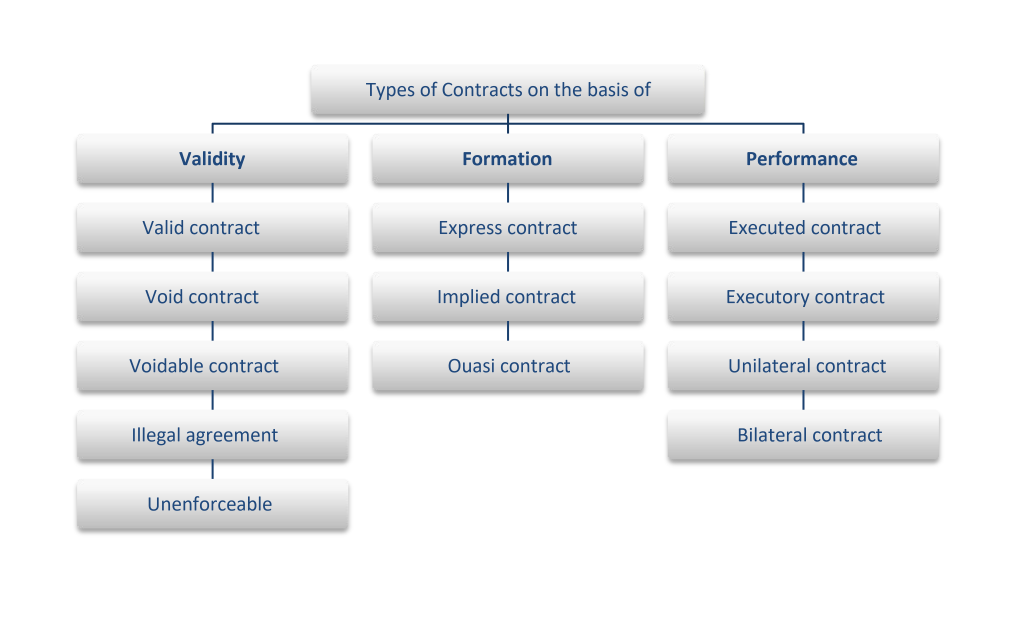
1. Void Contract: Section 2 (j) states as follows: “A contract which ceases to be enforceable by law becomes void when it ceases to be enforceable”. Thus a void contract is one which cannot be enforced by a court of law.
Example : Mr. X agrees to write a book with a publisher. After few days, X dies in an accident. Here the contract becomes void due to the impossibility of performance of the contract .
It may be added by way of clarification here that when a contract is void, it is not a contract at all but for the purpose of identifying it , it has to be called a [void] contract.
2. Voidable Contract: Section 2(i) defines that an agreement which is enforceable by law at the option of one or more parties but not at the option of the other or others is a voidable contract. This infact means where one of the parties to the agreement is in a position or is legally entitled or authorized to avoid performing his part, then the agreement is treated and becomes voidable. Such a right might arise from the fact that the contract may have been brought about by one of the parties by coercion, undue influence, fraud or misrepresentation and hence the other party has a right to treat it as a voidable contract.
At this juncture it would be desirable to know the distinction between a void contract and a voidable contract. The distinctions lie in three aspects namely definition, nature and rights. These are elaborated hereunder:
- Definition: A void contract cannot be enforced at all. A voidable contract is an agreement which is enforceable only at the option of one of the parties but not at the option of the other. Therefore ‘enforceability’ or otherwise, divides the two types of contracts.
- Nature: By nature, a void contract is valid at the time when it is made but becomes unenforceable and thus void on account of subsequent developments or events like supervening impossibility, subsequent illegality etc., Repudiation of a voidable contract also renders the contract void. Similarly a contingent contract might become void when the occurrence of the event on which it is contingent becomes impossible.
On the other hand voidable contract would remain valid until it is rescinded by the person who has the option to treat it as voidable. The right to treat it as voidable does not invalidate the contract until such right is exercised. All contracts caused by coercion, undue influence, fraud, misrepresentation are voidable. Generally, a contract caused by mistake is void.
- Rights: As regards rights of the parties, in the case of a void contract there is no legal remedy for the parties as the contract cannot be performed in any way. In the case of voidable contract the aggrieved party has a right to rescind it within a reasonable time. If it is so rescinded, it becomes void. If it is not rescinded, it is a valid contract.
3. llegal Contract: Illegal contract are those that are forbidden by law. All illegal contracts are hence void also. Because of the illegality of their nature they cannot be enforced by any court of law. In fact even associated contracts cannot be enforced. Contracts which are opposed to public policy or immoral are illegal. Similarly contracts to commit crime like supari contracts are illegal contracts.
The above discussion shows that illegal contracts are at par with void contracts. The Act specifies several factors which would render an agreement void. One such factor is unlawful nature of contract or the consideration meant for it. Though illegal agreements and void agreements appear similar they differ in the following manner:
- Scope: All illegal agreements are void. However void agreements might not be illegal at the time of entering but would have become void because of some other factors. For example, where the terms of the agreement are uncertain the agreement would not be illegal but might be treated as void. An illegal contract would encompass a void contract where as a void contract may not include in its scope illegal contracts.
- Nature and character: Illegal agreements are void since the very beginning they are invariably described as void ab initio. As already emphasized under the scope, a contract by nature, which is valid, can subsequently change its character and can become void.
- Effect on collateral transactions: In the case of illegal contract, even the collateral transactions namely transactions which are to be complied with before or after or concurrently along with main contract also become not enforceable. In contrast in the case of voidable contracts the collateral transactions can be enforced despite the fact that the main contract may have become voidable, to the extent the collateral transactions are capable of being performed independently.
- Penalty or punishment: All illegal agreements are punishable under different laws say like Indian Penal Code etc. Whereas parties to void agreements do not face such penalties or punishments.
Further classification of contracts according to the formation is also possible. Under this sub- classification the following contracts fall:
4. Express Contracts: A contract would be an express contract if the terms are expressed by words or in writing. Section 9 of the Act provides that if a proposal or acceptance of any promise is made in words the promise is said to be express.
5. Implied Contracts: Implied contracts in contrast come into existence by implication. Most often the implication is by law and or by action. Section 9 of the Act contemplates such implied contracts when it lays down that in so far as such proposal or acceptance is made otherwise than in words, the promise is said to be implied. For instance ‘A’ delivers goods by mistake at the warehouse of ‘B’ instead of that of ‘C’. Here ‘B’ not being entitled to receive the goods is obliged to return the goods to ‘A’ although there was no such contract to that effect.
6. Tacit Contracts: Tacit contracts are those that are inferred through the conduct of parties. A classic example of tacit contract would be when cash is withdrawn by a customer of a bank from the automatic teller machine [ATM]. Another example of of tacit contract is where a contract is assumed to have been entered when a sale is given effect to at the fall of hammer in an auction sale.
Further classification of contracts is possible on the basis of their performance. They are:
7. Executed Contract: The consideration in a given contract could be an act or
forbearance. When the act is done or executed or the forbearance is brought on record, then the contract is an executed contract.
8. Executory Contract: In an executory contract the consideration is reciprocal promise or obligation. Such consideration is to be performed in future only and therefore these contracts are described as executory contracts.
9. Unilateral Contract: Unilateral contract is a one sided contract in which only one party has to perform his duty or obligation.
10. Bilateral Contract: A Bilateral contract is one where the obligation or promise is outstanding on the part of both the parties.
Now let us take a look at yet another type of classification of contracts from the view point of English Law.
The English law classifies contracts as (i) Formal contracts and (ii) Simple contracts.
Formal contracts are further classified as (a) Contract of Record and (b) Contract under Seal.
- Contract of Record: A contract of record derives its binding force from the authority of court. The authority of court is invariably through judgment of a court or by way of recognizance. The judgment of a court is technically not a contract as it is not based on the agreement between parties. However the judgment is binding on all the persons who are litigants. The judgment creates certain rights on certain persons and obligation on certain other persons. A recognizance, on the other hand is a written acknowledgement of a debt due to the state generally in the context of criminal proceedings.
- Contract under Seal: A contract under seal is one which derives its binding force from its form alone. It is in writing, duly signed and sealed and delivered to parties. It is also referred to as a deed or a specialty contract.
Simple contracts as against formal contracts are devoid of all the formalities referred above.
 Law Notes